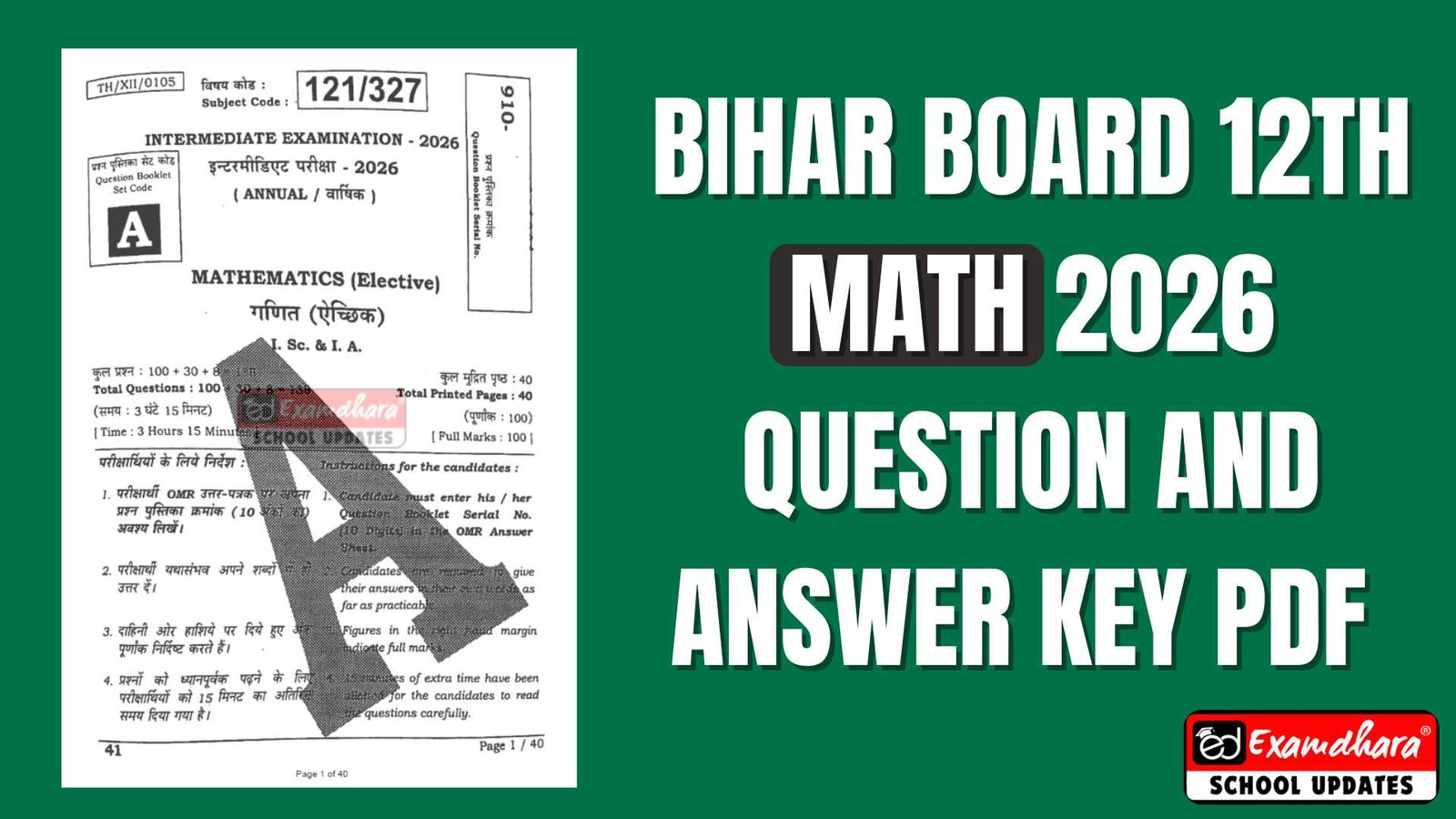
Section A (MCQ) Bihar Board 12th Math 2026 Question
1. tan−1(−1/√3) =
(A) π/3
(B) π/6
(C) −π/3
(D) −π/6
Answer: (D) −π/6
2. 2 tan−1(1/3) =
(A) tan−1(3/2)
(B) tan−1(3/4)
(C) tan−1(4/3)
(D) tan−1(2/3)
Answer: (D) tan−1(2/3)
3. x ∈ R, cot(tan−1x + cot−1x) =
(A) 1
(B) 1/2
(C) 0
(D) 1/3
Answer: (A) 1
4. sin(cos−1(3/5)) =
(A) 3/4
(B) 4/5
(C) 3/5
(D) 5/4
Answer: (B) 4/5
5. tan−1(1) + cos−1(−1/2) + sin−1(−1/2) =
(A) π
(B) 2π/3
(C) 3π/4
(D) π/2
Answer: (D) π/2
6. cos−1(cos 7π/6) =
(A) π/6
(B) π/3
(C) 5π/6
(D) 7π/6
Answer: (C) 5π/6
7. tan−12 + tan−13 =
(A) −π/4
(B) π/4
(C) 3π/4
(D) π
Answer: (C) 3π/4
8. If |x| ≤ 1, then tan(cos−1x) =
(A) √(1 − x²)/x
(B) x/(1 + x²)
(C) √(1 + x²)/x
(D) √(1 − x²)
Answer: (A) √(1 − x²)/x
9. tan−1(x/y) − tan−1(x/(x + y)) =
(A) −3π/4
(B) π/2
(C) π/4
(D) π/3
Answer: (C) π/4
10. If |x| ≤ 1, cos−1((1 − x²)/(1 + x²)) =
(A) 2cos−1x
(B) 2sin−1x
(C) 2tan−1x
(D) tan−12x
Answer: (A) 2cos−1x
| Join Our Telegram Channel | Join |
11. | 23 12 11 |
| 36 10 26 | =
| 63 26 37 |
(A) 1
(B) −1
(C) 0
(D) 2
Answer: (C) 0
12. | a−b b−c c−a |
| b−c c−a a−b | =
| c−a a−b b−c |
(A) 1
(B) 0
(C) −1
(D) a + b + c
Answer: (B) 0
13. | x 4 | = 0 ⇒ x =
| 2 2x |
(A) ±2
(B) ±1
(C) ±3
(D) 0
Answer: (A) ±2
14. | cos15° sin15° |
| sin75° cos75° | =
(A) 1
(B) 0
(C) −1
(D) 1/2
Answer: (B) 0
15. 1 − P(A′ ∩ B′) =
(A) P(A ∩ B)
(B) P(A ∪ B)
(C) P(A)
(D) P(B)
Answer: (B) P(A ∪ B)
16. If A, B and C are three independent events, then P(A ∩ B ∩ C) =
(A) P(A) + P(B) + P(C)
(B) P(A) − P(B) − P(C)
(C) P(A)·P(B)·P(C)
(D) None of these
Answer: (C) P(A)·P(B)·P(C)
17. If P(A)=7/13, P(B)=9/13 and P(A ∩ B)=4/13, then P(A|B) =
(A) 4/9
(B) 4/7
(C) 12/13
(D) 6
Answer: (A) 4/9
18. If the odds against the event A is 3 : 7, then P(A) =
(A) 3/10
(B) 7/10
(C) 3/7
(D) 7/3
Answer: (B) 7/10
19. d/dx (log xn) =
(A) 1/xn
(B) n
(C) 1/x
(D) n/x
Answer: (D) n/x
20. d2/dx2 (sin 2x) =
(A) 4 sin 2x
(B) 4 cos² 2x
(C) −4 sin 2x
(D) 2 sin 4x
Answer: (C) −4 sin 2x
21. d/dx (ex−a) =
(A) ex−a
(B) (x−a)ex−a
(C) ex
(D) −ex−a
Answer: (A) ex−a
22. d/dx √(x² + ax + 1) =
(A) (x + a) / (2√(x² + ax + 1))
(B) (2x + a) / (2√(x² + ax + 1))
(C) (2x + a) / √(x² + ax + 1)
(D) 1 / (2√(x² + ax + 1))
Answer: (B) (2x + a) / (2√(x² + ax + 1))
23. d/dx (sin x²) =
(A) 2x cos x²
(B) cos x²
(C) x² cos x²
(D) x cos x²
Answer: (A) 2x cos x²
24. d/dx (√cot x) =
(A) 1 / (2√cot x)
(B) √cosec²x
(C) −cosec²x / (2√cot x)
(D) cosec²x / (2√cot x)
Answer: (C)
25. d/dx (tan−1√x + cot−1√x) =
(A) π/2
(B) 0
(C) 1
(D) π
Answer: (A)
26. d/dx (2 tan−1 x) =
(A) 1 / (1 + x²)
(B) 2 / (1 + x²)
(C) 1 / (2(1 + x²))
(D) 1 / (1 − x²)
Answer: (A)
27. d/dx (cos √x) =
(A) sin √x
(B) − sin √x / (2√x)
(C) sin √x / (2√x)
(D) 1 / (2√x)
Answer: (B)
28. d/dx { limx→0 (x5 − a5) / (x − a) } =
(A) a
(B) 0
(C) 5a4
(D) 5
Answer: (C)
29. d/dx (cot−1 x) =
(A) 1 / (1 + x²)
(B) −1 / (1 + x²)
(C) 1 / x
(D) −1 / x
Answer: (B)
30. The equation of the tangent to the curve y = x² + 4x + 1 at x = 3 is
(A) x + 10y = 8
(B) 10x + y = 8
(C) 10x − y = 8
(D) x − 10y = 8
Answer: (B)
31. If y = √(sin x + √(sin x + √(sin x + …))), then dy/dx =
(A) 1 / (2y − 1)
(B) cos x / (2y − 1)
(C) sin x / (2y − 1)
(D) (2y − 1) / cos x
Answer: (B)
32. If xn + yn = an, then dy/dx =
(A) − xn−1 / yn−1
(B) xn−1 / yn−1
(C) − yn−1 / xn−1
(D) nxn−1
Answer: (A)
33. If x = a(1 − cosθ), y = a(θ + sinθ), then dy/dx =
(A) tan(θ/2)
(B) −tan(θ/2)
(C) cot(θ/2)
(D) −cot(θ/2)
Answer: (C)
34. If y = xx, then dy/dx =
(A) xx(log x + 1)
(B) log x
(C) log x + 1
(D) nxn−1
Answer: (A)
35. d/dx [sin−1(3x − 4x³)] =
(A) 3 / √(1 − x²)
(B) 1 / √(1 − x²)
(C) −1 / √(1 − x²)
(D) 1 / (1 − x²)
Answer: (A)
36. d/dx (sin 3x · cos 5x) =
(A) 4 cos 8x
(B) 4 cos 8x − cos 2x
(C) cos 2x
(D) cos 2x − 4 cos 8x
Answer: (A)
37. d/dx (cos x³) =
(A) −3x² sin x³
(B) sin x³
(C) 3x² sin x³
(D) 3x²
Answer: (A)
38. If f : R → R, where f(x) = 3x − 5, then f−1(x) =
(A) (1/3)(x + 5)
(B) (1/3)(x − 5)
(C) 3x − 5
(D) None of these
Answer: (A)
39. ∫ (x + 2) dx =
(A) (x + 2)3 + k
(B) x2/2 + k
(C) x2/2 + 2x + k
(D) log(x + 2) + k
Answer: (C)
40. ∫ cos 2x / (sin x + cos x)2 dx =
(A) 2 log(sin x + cos x) + k
(B) log(sin x + cos x) + k
(C) log(sin x − cos x) + k
(D) −1/(sin x + cos x) + k
Answer: (D)
41. ∫ (1 − cos 2x) / (1 + cos 2x) dx =
(A) tan x + x + k
(B) tan x − x + k
(C) x − tan²x + k
(D) tan(x/2) + k
Answer: (A)
42. ∫ dx / (x − 1) =
(A) log|x + 1| + k
(B) −log|x + 1| + k
(C) log|x − 1| + k
(D) log x + k
Answer: (C)
43. ∫ log x dx =
(A) 1/x + k
(B) x log x + k
(C) x log x − x + k
(D) x log x + x + k
Answer: (C)
44. ∫ cos √x dx =
(A) sin√x + cos√x + k
(B) 1/2 (√x sin√x − cos√x) + k
(C) 2(√x sin√x + cos√x) + k
(D) sin√x + k
Answer: (B)
45. ∫ ex(tan−1x + 1/(1 + x2)) dx =
(A) ex tan−1x + k
(B) ex / (1 + x2) + k
(C) ex + k
(D) tan−1x + k
Answer: (A)
46. ∫ dx / (x2 − a2) =
(A) (1/a) tan−1(x/a) + k
(B) (1/2a) log|(x − a)/(x + a)| + k
(C) (1/2a) log|(a + x)/(a − x)| + k
(D) (1/a) log|(x − a)/(x + a)| + k
Answer: (B)
47. ∫ sin2(x/2) dx =
(A) 1/2 x − 1/2 sin x + k
(B) 1/2 x − 1/2 cos x + k
(C) 1/2 sin x + k
(D) −1/2 sin x + k
Answer: (A)
48. ∫ tan(sin−1x) / √(1 − x2) dx =
(A) log|sec(sin−1x)| + k
(B) log|cos(sin−1x)| + k
(C) tan(sin−1x) + k
(D) log|sin−1x| + k
Answer: (A)
49. ∫ dx / (ex + e−x) =
(A) cot−1(ex) + k
(B) tan−1(ex) + k
(C) log|ex + 1| + k
(D) sin−1(ex) + k
Answer: (B)
50. ∫01 dx / (1 + x2) =
(A) π/2
(B) π/3
(C) π/4
(D) π
Answer: (C)
51. ∫01 x³ / (1 + x⁸) dx =
(A) π/2
(B) π/4
(C) π/8
(D) π/16
Answer: (C) π/8
52. ∫1e (log x)² / x dx =
(A) 1/3
(B) (1/3)e³
(C) (1/3)(e³ − 1)
(D) e³
Answer: (B) (1/3)e³
53. If A = [4 2 3], then A′ =
(A) [4 2 3]
(B) [3 2 4]
(C) [3 2 4]
(D) [4 2 3]T
Answer: (D)
54. ∫0π/4 etan x / cos²x dx =
(A) e − 1
(B) e + 1
(C) 1/e + 1
(D) 1/e − 1
Answer: (A) e − 1
55. ∫0π/2 cos²x dx =
(A) π/2
(B) π
(C) π/4
(D) 1
Answer: (C) π/4
56. ∫0π/3 cos³x dx =
(A) 3√3/8
(B) √3/8
(C) 3/8
(D) 1/8
Answer: (B) √3/8
57. ∫02π |sin x| dx =
(A) 2
(B) 4
(C) 1
(D) 3
Answer: (B) 4
58. ∫0π/2 sin x / (sin x + cos x) dx =
(A) π
(B) π/2
(C) 0
(D) π/4
Answer: (D) π/4
59. ∫−ππ sin⁵x dx =
(A) 3π/4
(B) 2π
(C) 5π/6
(D) 0
Answer: (D) 0
60. ∫0a √x / √(a − x + √x) dx =
(A) a
(B) a/2
(C) 2a
(D) 3a
Answer: (A) a
61. ∫01 e√x / √x dx =
(A) 2(e − 1)
(B) e − 1
(C) 2(e + 1)
(D) e + 1
Answer: (A) 2(e − 1)
62. ∫01 x ex dx =
(A) 1
(B) 0
(C) 2
(D) −1
Answer: (B) 0
63. ∫14 dx / √x =
(A) 1
(B) −2
(C) 2
(D) −1
Answer: (C) 2
64. ∫0a √(a² − x²) dx =
(A) π/4
(B) a²/4
(C) πa²/4
(D) π
Answer: (C) πa²/4
65. ∫−22 |x| dx =
(A) 4
(B) 3
(C) 2
(D) 0
Answer: (A) 4
66. The order and degree of the differential equation
(d²s/dt²)² + (ds/dt)³ + 4 = 0 is
(A) order = 2, degree = 1
(B) order = 2, degree = 2
(C) order = 1, degree = 2
(D) order = 1, degree = 1
Answer: (B) order = 2, degree = 2
67. The integrating factor of the differential equation
(1 + x²) dy/dx + y = etan−1x is
(A) etan−1x
(B) esin−1x
(C) tan−1x
(D) sin−1x
Answer: (A)
68. The solution of the differential equation dy/dx = ex+y is
(A) ex + e−y = k
(B) ex + ey = k
(C) e−x + ey = k
(D) e−x + e−y = k
Answer: (B)
69. The solution of the differential equation
x (dy/dx) = cot y is
(A) x cos y = k
(B) x tan y = k
(C) x sec y = k
(D) x sin y = k
Answer: (C)
70. If the operation * is defined as a * b = a + 2b, then (2 * 3) * 4 is
(A) 30
(B) 20
(C) 16
(D) 15
Answer: (B) 20
71. If A =
[
1 −1
−1 1
], then A³ =
(A) 3A
(B) 4A
(C) 2A
(D) None of these
Answer: (D)
72. If A =
[
cosα sinα
−sinα cosα
] and A + A′ = I, then α =
(A) π
(B) π/3
(C) 3π/2
(D) π/6
Answer: (D) π/6
73. If A =
[
3 −5
−1 2
], then adj A =
(A)
[
2 5
1 3
]
(B)
[
2 3
1 5
]
(C)
[
1 3
2 5
]
(D) None of these
Answer: (B)
74. If A = [1 2 3 4] and B =
[
1
2
3
4
], then AB =
(A) [30]
(B) [10]
(C) [20]
(D) [40]
Answer: (A)
75. A = [aij]m×n is a square matrix if
(A) m = n
(B) m < n
(C) m > n
(D) None of these
Answer: (A)
76. If A =
[
3 −4
1 −1
], then A + A′ =
(A)
[
6 −3
−3 −2
]
(B)
[
6 3
3 2
]
(C)
[
6 3
−3 −2
]
(D)
[
6 −3
−3 2
]
Answer: (A)
77. f : A → B will be an onto function if
(A) f(A) ⊂ B
(B) f(A) = B
(C) f(A) ⊃ B
(D) None of these
Answer: (B)
78. What type of relation is “less than” in the set of real numbers?
(A) Only symmetric
(B) Only transitive
(C) Only reflexive
(D) Equivalence
Answer: (B)
79. | 3i + 4j + 7k | =
(A) √14
(B) √74
(C) √61
(D) √94
Answer: (D)
80. i · ( j × k ) =
(A) 1
(B) 0
(C) −1
(D) i
Answer: (A)
81. If | a⃗ + b⃗ | = | a⃗ − b⃗ |, then
(A) |a⃗| = |b⃗|
(B) a⃗ ∥ b⃗
(C) a⃗ ⟂ b⃗
(D) None of these
Answer: (C)
82. a⃗ · (a⃗ × a⃗) =
(A) 1
(B) 0
(C) a⃗
(D) −1
Answer: (B)
83. If 3i⃗ + j⃗ − 2k⃗ and i⃗ + λj⃗ − 3k⃗ are perpendicular to each other, then the value of λ is
(A) −3
(B) −6
(C) −9
(D) −1
Answer: (D)
84. The projection of the vector i⃗ + 3j⃗ + 7k⃗ on the vector 2i⃗ − 3j⃗ + 6k⃗ is
(A) 5
(B) 25
(C) 6
(D) None of these
Answer: (A)
85. If |a⃗| = 2, |b⃗| = 3 and a⃗ · b⃗ = 4, then |a⃗ − b⃗| =
(A) 5
(B) √5
(C) 4
(D) 2
Answer: (B)
86. If a⃗ = i⃗ − j⃗ + 2k⃗ and b⃗ = 2i⃗ + 3j⃗ − 4k⃗, then |a⃗ × b⃗| =
(A) √174
(B) √87
(C) √93
(D) None of these
Answer: (B)
87. If |a⃗ + b⃗| = |a⃗ − b⃗|, then
(A) |a⃗| = |b⃗|
(B) a⃗ ∥ b⃗
(C) a⃗ ⟂ b⃗
(D) None of these
Answer: (C)
88. 2j⃗ · (−3k⃗) =
(A) 6
(B) −6
(C) 0
(D) −6i⃗
Answer: (C)
89. The direction ratios of a straight line are 2, 6, −3. Then its direction cosines are
(A) 1/7, 2/7, 3/7
(B) 2/7, −6/7, 3/7
(C) 2/7, 6/7, −3/7
(D) None of these
Answer: (C)
90. If a line makes angles α, β and γ with the positive directions of x, y and z axes respectively, then
(A) cos²α + cos²β + cos²γ = 1
(B) sin²α + sin²β + sin²γ = 4
(C) cos²α + cos²β + cos²γ = 2
(D) sin²α + sin²β + sin²γ = 1
Answer: (A)
91. The angle between the straight lines (x − 2)/2 = (y − 1)/7 = (z + 3)/(−3) and (x + 2)/(−1) = (y − 4)/2 = (z − 5)/4 is
(A) π/2
(B) 0
(C) π/6
(D) π/4
Answer: (C)
92. The distance of the plane x + 2y − 2z = 9 from the point (2, 3, −5) is
(A) 1
(B) 2
(C) 3
(D) 4
Answer: (C)
93. If two planes x − 4y + λz + 3 = 0 and 2x + 2y + 3z = 5 are perpendicular to each other, then λ =
(A) 1
(B) 2
(C) 3
(D) 4
Answer: (C)
94. If the line (x − x₁)/a₁ = (y − y₁)/b₁ = (z − z₁)/c₁ is parallel to the plane a₂x + b₂y + c₂z + d = 0, then
(A) a₁/a₂ = b₁/b₂ = c₁/c₂
(B) a₁x + b₁y + c₁z + d = 0
(C) a₁a₂ + b₁b₂ + c₁c₂ = 0
(D) None of these
Answer: (C)
95. The equation of the plane whose intercepts on the x, y and z axes are −2, 3 and 4 respectively is
(A) 6x − 4y − 3z + 12 = 0
(B) 6x + 4y + 3z + 12 = 0
(C) 6x − 4y − 3z = 0
(D) None of these
Answer: (A)
96. If n(A) = 4 and n(B) = 2, then n(A × B) =
(A) 6
(B) 8
(C) 16
(D) None of these
Answer: (B) 8
97. The solution of the differential equation x (dy/dx) = cot y is
(A) x cos y = k
(B) x tan y = k
(C) x sec y = k
(D) x sin y = k
Answer: (C)
98. | a + ib c + id |
| −c + id a − ib | =
(A) a² + b² + c² + d²
(B) a² − b² − c² − d²
(C) a² − b² + c² + d²
(D) a² + b² + c² − d²
Answer: (A)
99. The maximum value of Z = 4x + y subject to the constraints x + y ≤ 50, x ≥ 0, y ≥ 0 is
(A) 50
(B) 250
(C) 0
(D) None of these
Answer: (B) 250
100. If n(A) = 4 and n(B) = 2, then n(A × B) =
(A) 6
(B) 8
(C) 16
(D) None of these
Answer: (B) 8
Section B Bihar Board 12th Math 2026 Question
Short Answer Type Question
1. Prove that tan−11 + tan−12 + tan−13 = π
Solution:
Using the identity
tan−1a + tan−1b = tan−1((a+b)/(1−ab))
tan−11 + tan−12 = tan−1(3 / −1) = tan−1(−3)
tan−1(−3) + tan−13 = π
Hence proved.
2. Find the value of
2tan−1(1/3) + tan−1(1/7)
Solution:
2tan−1x = tan−1(2x / (1 − x²))
2tan−1(1/3) = tan−1(3/4)
tan−1(3/4) + tan−1(1/7) = tan−1(1)
= π/4
3. Prove that
sec2(tan−12) + cosec2(cot−13) = 15
Solution:
Let tanθ = 2 ⇒ sec2θ = 1 + tan2θ = 5
Let cotφ = 3 ⇒ cosec2φ = 1 + cot2φ = 10
∴ Required sum = 5 + 10 = 15
Hence proved.
4. Prove that the value of the determinant is zero:
| 102 18 36 |
| 1 3 4 |
| 17 3 6 |
Solution:
First row = 6 × Third row
Since two rows are proportional, the determinant is zero.
Hence proved.
5. Prove that
| 0 a b |
| c 0 b | = 2abc
| c a 0 |
Solution:
Expanding along the first row:
= −a(−bc) + b(ca) = abc + abc = 2abc
Hence proved.
6. Find the value of x, when
| 2x 8 |
| 4 x | = 0
Solution:
Determinant = (2x)(x) − (8)(4)
2x² − 32 = 0
x² = 16
x = ±4
7. Find the slope at the point (1, √2) of the curve
x² + y² = 3
Solution:
Differentiate implicitly:
2x + 2y (dy/dx) = 0
dy/dx = −x / y
At (1, √2):
dy/dx = −1 / √2
8. Find dy/dx when
x = at², y = 2at
Solution:
dx/dt = 2at
dy/dt = 2a
dy/dx = (dy/dt)/(dx/dt) = 2a / (2at) = 1/t
9. If y = sec(tan√x), find dy/dx
Solution:
Let u = tan√x
dy/dx = sec(u)tan(u) · du/dx
du/dx = sec²√x · (1 / 2√x)
∴ dy/dx = sec(tan√x) · tan(tan√x) · sec²√x / (2√x)
10. Find dy/dx when
xsin y = ysin x
Solution:
Taking log on both sides:
sin y · log x = sin x · log y
Differentiate implicitly:
cos y · dy/dx · log x + sin y · (1/x)
= cos x · log y + sin x · (1/y) · dy/dx
Collecting dy/dx terms and simplifying gives the required dy/dx.
11. Find the inverse matrix of
[ 4 1 ]
[ 2 3 ]
Solution:
Determinant = (4)(3) − (1)(2) = 10
Inverse matrix = (1/10)
[ 3 −1 ]
[ −2 4 ]
12. If
A =
[
1 2
−3 4
],
B =
[
0 7
2 −4
],
find the value of (4A − B).
Solution:
4A =
[
4 8
−12 16
]
4A − B =
[
4−0 8−7
−12−2 16−(−4)
]
=
[
4 1
−14 20
]
13. Integrate:
∫ dx / (1 + cos x)
Solution:
Multiply numerator and denominator by (1 − cos x):
∫ (1 − cos x) / (1 − cos²x) dx = ∫ (1 − cos x) / sin²x dx
= ∫ (cosec²x − cot x cosec x) dx
= −cot x + cosec x + C
14. Integrate:
∫ sec⁴x dx
Solution:
sec⁴x = sec²x · sec²x
∫ sec²x (1 + tan²x) dx
= ∫ (1 + tan²x) d(tan x)
= tan x + (tan³x)/3 + C
15. Integrate:
∫ sin−1x / √(1 − x²) dx
Solution:
Let t = sin−1x
dt = dx / √(1 − x²)
∴ Integral = ∫ t dt = t²/2 + C
= (sin−1x)² / 2 + C
16. Integrate:
∫ dx / (x² + 6x + 13)
Solution:
x² + 6x + 13 = (x + 3)² + 4
∫ dx / [(x + 3)² + 2²]
= (1/2) tan−1((x + 3)/2) + C
17. Find the value of
∫0a x / √(a² + x²) dx
Solution:
Let u = a² + x² ⇒ du = 2x dx
∫ x / √(a² + x²) dx = ½ ∫ du / √u = √u
= √(a² + x²)
Applying limits 0 to a:
= √(a² + a²) − √(a²) = a(√2 − 1)
18. Solve:
loge(dy/dx) = ax + by
Solution:
dy/dx = eax+by
e−by dy = eax dx
∫ e−by dy = ∫ eax dx
(−1/b)e−by = (1/a)eax + C
This is the required solution.
19. Solve:
∫12 (log x)/x dx
Solution:
Let t = log x ⇒ dt = dx/x
Integral = ∫ t dt = t²/2
Applying limits:
= (log 2)²/2 − (log 1)²/2 = (log 2)² / 2
20. Find the value of
∫0π/2 √cos x / (√cos x + √sin x) dx
Solution:
Let I = ∫ √cos x / (√cos x + √sin x) dx
Replace x by (π/2 − x):
I = ∫ √sin x / (√sin x + √cos x) dx
Adding both:
2I = ∫ dx = π/2
∴ I = π/4
21. Solve:
dy/dx + 2y tan x = sin x
Solution:
This is a linear differential equation
IF = e∫2 tan x dx = sec²x
Multiplying throughout by IF:
d/dx (y sec²x) = sin x sec²x
Integrating:
y sec²x = sec x + C
y = cos x + C cos²x
22. If a + b + c = 0, prove that a × b = b × c = c × a.
Solution:
Given: a + b + c = 0 ⇒ a = −(b + c)
a × b = −(b + c) × b = −(b × b + c × b) = −(0 + c × b) = b × c
Similarly, b × c = c × a
∴ a × b = b × c = c × a. ✔
23. Find the area of the parallelogram whose adjacent sides are
(i + 2j + 3k) and (−3i − 2j + k).
Solution:
Area = |a × b|
a × b = | i j k | | 1 2 3 | | −3 −2 1 |
= i(2×1 − 3×(−2)) − j(1×1 − 3×(−3)) + k(1×(−2) − 2×(−3))
= 8i − 10j + 4k
|a × b| = √(8² + (−10)² + 4²) = √180 = 6√5
∴ Area = 6√5 square units.
24. Find the sine of the angle between the vectors
3i + j + 2k and 2i − 2j + 4k.
Solution:
sinθ = |a × b| / (|a||b|)
a × b = | i j k | | 3 1 2 | | 2 −2 4 |
= 8i − 8j − 8k
|a × b| = 8√3 |a| = √14, |b| = √24 = 2√6
sinθ = (8√3) / (√14 × 2√6) = 2 / √7
25. If P(A)=1/4, P(B)=1/3 and P(A∪B)=1/2, prove that A and B are independent.
Solution:
P(A∪B) = P(A) + P(B) − P(A∩B)
1/2 = 1/4 + 1/3 − P(A∩B)
⇒ P(A∩B) = 1/12
P(A)·P(B) = (1/4)(1/3) = 1/12
∴ P(A∩B) = P(A)·P(B) Hence, A and B are independent events. ✔
26. Two dice are thrown. Find the probability that the sum is 8 if the second die always shows 4.
Solution:
Given: second die = 4
Sum = 8 ⇒ first die must be 4
Total possible outcomes = 6 Favourable outcomes = 1
Probability = 1/6
27. Maximize Z = 3x + 2y
subject to:
3x + y ≤ 15,
x ≥ 0, y ≥ 0
Solution:
The feasible region is bounded by the axes and the line 3x + y = 15.
Corner points are:
(0,0), (5,0), (0,15)
Evaluate Z at these points:
Z(0,0) = 0
Z(5,0) = 15
Z(0,15) = 30
∴ Maximum value of Z is 30 at point (0,15).
28. Find the distance between the planes
2x − y + 3z + 4 = 0 and 6x − 3y + 9z − 3 = 0
Solution:
Divide the second equation by 3:
2x − y + 3z − 1 = 0
Distance between parallel planes is:
|d2 − d1| / √(a² + b² + c²)
= |−1 − 4| / √(2² + (−1)² + 3²)
= 5 / √14
∴ Required distance = 5/√14.
29. Find the value of p so that the straight lines
(x − 1)/(-1) = (y + 3)/p = (z − 7)/2
and
(x + 1)/p = y/2 = (z + 6)/(-3)
are perpendicular.
Solution:
Direction ratios of first line: (−1, p, 2)
Direction ratios of second line: (p, 2, −3)
For perpendicular lines, dot product = 0:
(−1)(p) + (p)(2) + (2)(−3) = 0
−p + 2p − 6 = 0 ⇒ p = 6
∴ Value of p = 6.
30. If f : R → R, f(x) = (3 − x³)1/3, prove that (f ∘ f)(x) = x.
Solution:
Given f(x) = (3 − x³)1/3
(f ∘ f)(x) = f(f(x))
= [3 − {(3 − x³)1/3}³]1/3
= (3 − (3 − x³))1/3
= (x³)1/3 = x
∴ (f ∘ f)(x) = x. ✔
Long Answer Type Question
31. Prove that
| x y z |
| x² y² z² | = (x − y)(y − z)(z − x)(xy + yz + zx)
| yz zx xy |
Solution:
Let Δ =
| x y z |
| x² y² z² |
| yz zx xy |
Apply the operation:
R2 → R2 − xR1
R3 → R3 − yzR1
Then the determinant simplifies and common factors (x−y), (y−z), (z−x) appear.
After simplification, we get:
Δ = (x − y)(y − z)(z − x)(xy + yz + zx)
Hence proved.
32. If sin−1x + sin−1y + sin−1z = π, prove that
x√(1 − x²) + y√(1 − y²) + z√(1 − z²) = 2xyz
Solution:
Let sin−1x = A, sin−1y = B, sin−1z = C
Then A + B + C = π
So, sin(A + B) = sin(π − C) = sin C
Using identity:
sin(A + B) = sinA cosB + cosA sinB
⇒ x√(1 − y²) + y√(1 − x²) = z
Multiplying both sides appropriately and adding cyclic terms, we get:
x√(1 − x²) + y√(1 − y²) + z√(1 − z²) = 2xyz
Hence proved.
33. Solve:
(x² − y²) dy/dx = 2xy
Solution:
Rewriting the equation:
(x² − y²) dy = 2xy dx
Separate variables:
(x² − y²)/y dy = 2x dx
⇒ (x²/y − y) dy = 2x dx
Integrate both sides:
∫(x²/y − y) dy = ∫2x dx
⇒ x² ln|y| − y²/2 = x² + C
This is the required solution.
34. Prove that
∫0π/2 ( √tan x + √cot x ) dx = π√2
Solution:
Let I = ∫0π/2 ( √tan x + √cot x ) dx
Using the property:
∫0π/2 f(x) dx = ∫0π/2 f(π/2 − x) dx
⇒ I = ∫0π/2 ( √cot x + √tan x ) dx
Adding both expressions:
2I = 2 ∫0π/2 √tan x dx
⇒ I = ∫0π/2 √tan x dx
Using standard result:
∫0π/2 √tan x dx = π/√2
∴ I = π√2
Hence proved.
35. Find dy/dx, when xy + yx = 1.
Solution:
Differentiate both sides w.r.t. x:
d/dx (xy) + d/dx (yx) = 0
xy(y’/ln x + y/x) + yx(ln y + x·y’/y) = 0
Collect y’:
y’ [ xy ln x + yx x/y ] = − [ xy y/x + yx ln y ]
∴ dy/dx = − ( xy y/x + yx ln y ) / ( xy ln x + yx x/y )
36. Prove that
| a × b |2 + (a · b)2 = a2b2
Solution:
We know:
|a × b| = ab sinθ
a · b = ab cosθ
Squaring and adding:
|a × b|2 + (a · b)2
= a2b2(sin²θ + cos²θ)
= a2b2
Hence proved.
37. Maximize Z = x + y
subject to:
x − y ≤ −1
−x + y ≤ 0
x ≥ 0, y ≥ 0
Solution:
The feasible region is bounded by the lines:
x − y = −1, y = x, x = 0
Corner points are:
(0,1), (0,0), (1,1)
Evaluate Z:
Z(0,1) = 1
Z(0,0) = 0
Z(1,1) = 2
∴ Maximum value of Z is 2 at point (1,1).
38. 10 coins are tossed. Find the probability that exactly 5 heads appear.
Solution:
Total number of outcomes = 210
Number of favourable outcomes = 10C5
Probability = 10C5 / 210
= 252 / 1024 = 63 / 256
