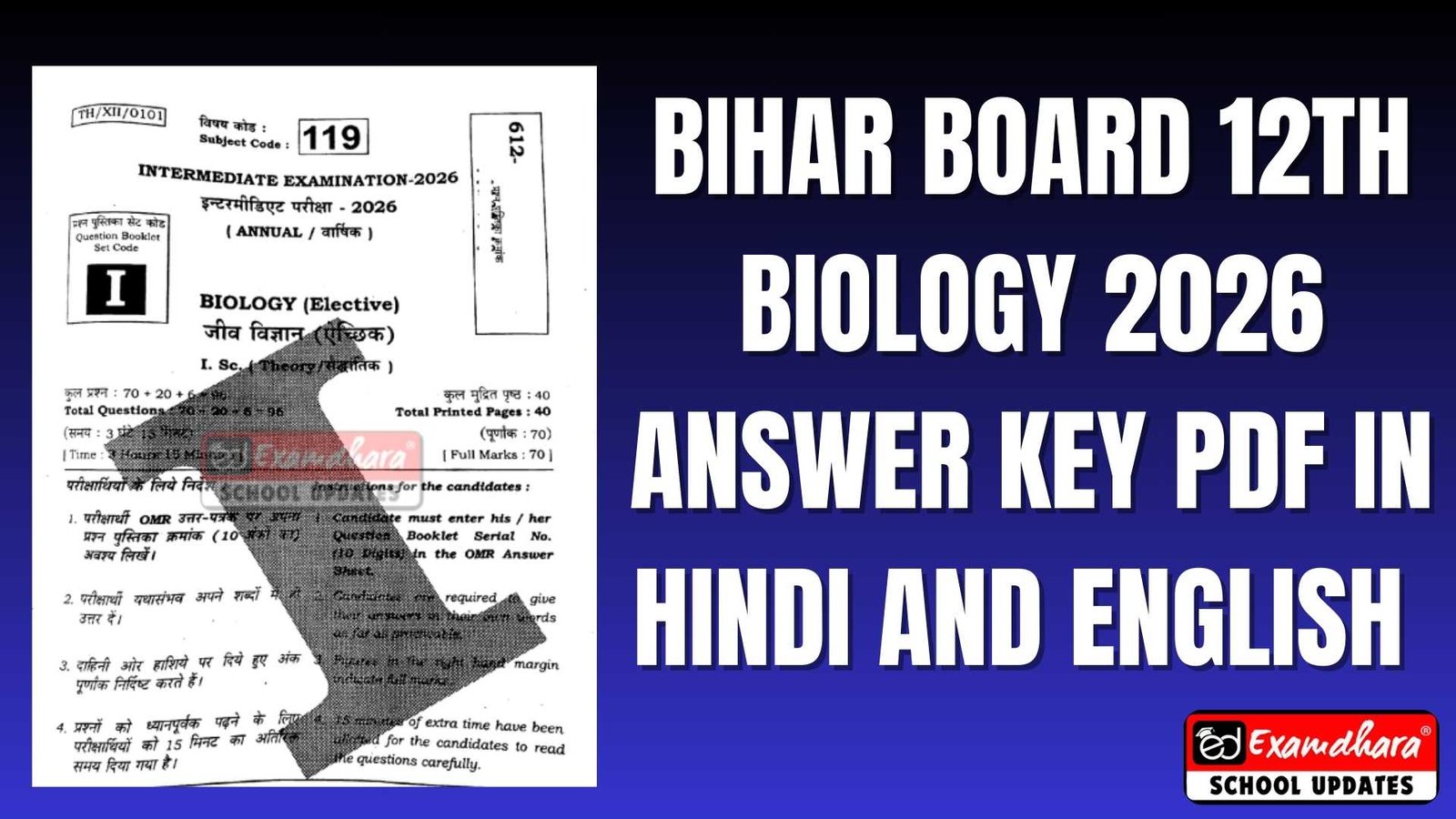
Bihar Board 12th Biology 2026 Answer Key in English
SECTION – A (Objective Type Questions)
Question Nos. 1 to 70 have four options, out of which only one is correct. You have to mark your selected option, on the OMR-Sheet. Answer any 35 questions. 35 x 1-35
1. Who of the following scientists observed that restriction endonuclease can cut DNA strands in a particular shape?
(A) Herbert Boyer
(B) Stanley Cohen
(C) Watson
(D) Crick
✅ Answer: (A) Herbert Boyer
2. Cutting DNA at a specific site is made possible by which enzyme?
(A) Restriction endonuclease
(B) Alkaline phosphatase
(C) DNA ligase
(D) Nuclease
✅ Answer: (A) Restriction endonuclease
3. In which of the following is the large volume of culture processed to produce appreciable quantities of products?
(A) Distillation unit
(B) Bioreactor
(C) PCR
(D) Electrophoresis unit
✅ Answer: (B) Bioreactor
4. The base pillar of both strands of DNA double helix is made of:
(A) Sugar–Phosphate
(B) Sugar–Nitrogenous base
(C) Nitrogenous base–Phosphate
(D) Sugar–Phosphate–Nitrogenous base
✅ Answer: (A) Sugar–Phosphate
5. What is essential for occurrence of the same kind of ‘sticky ends’ of DNA fragments?
(A) To cut DNA by the same restriction endonuclease
(B) To cut DNA by different restriction endonucleases
(C) DNA amplification
(D) All of these
✅ Answer: (A) To cut DNA by the same restriction endonuclease
6. During gel electrophoresis, fragments of DNA move towards which electrode?
(A) Cathode
(B) Anode
(C) Towards any electrode depending upon size
(D) None of these
✅ Answer: (B) Anode
7. Which of the following is the sequence from where replication starts in cloning vector?
(A) tetᴿ
(B) ampᴿ
(C) ori
(D) More than one
✅ Answer: (C) ori
8. Which of the following cells are found in seminiferous tubules?
(A) Sertoli cells
(B) Interstitial cells
(C) Spermatogonia
(D) Both (A) and (C)
✅ Answer: (D) Both (A) and (C)
9. After how many months of pregnancy do the limbs and digits of foetus develop?
(A) One month
(B) Two months
(C) Three months
(D) Six months
✅ Answer: (B) Two months
10. Which of the following placental hormones is produced during pregnancy?
(A) hCG
(B) hPL
(C) Relaxin
(D) All of these
✅ Answer: (D) All of these
11. In which structure of sperm are the enzymes present which help in fertilisation of the ovum?
(A) Middle piece
(B) Neck
(C) Nucleus
(D) Acrosome
✅ Answer: (D) Acrosome
12. Which of the following cells is haploid?
(A) Oogonia
(B) Primary oocyte
(C) Secondary oocyte
(D) All of these
✅ Answer: (C) Secondary oocyte
13. What is the main role of large amount of progesterone secreted by corpus luteum?
(A) Maintenance of endometrium of uterus
(B) Maintenance of perimetrium of uterus
(C) Maintenance of myometrium of uterus
(D) None of these
✅ Answer: (A) Maintenance of endometrium of uterus
14. What is it called when an embryo having more than eight blastomeres is transferred to the uterus for development?
(A) IVF
(B) Intrauterine Transfer
(C) Zygote Intra-fallopian Transfer
(D) ICSI
✅ Answer: (B) Intrauterine Transfer
15. If a person’s blood group is AB, what would be his/her genotype?
(A) Iᴬi
(B) Iᴮi
(C) ii
(D) IᴬIᴮ
✅ Answer: (D) IᴬIᴮ
16. How many types of gametes would be formed if the genotype of plant is AaBbCc?
(A) Two
(B) Four
(C) Eight
(D) Sixteen
✅ Answer: (C) Eight
17. Which of the following is not a chromosomal disorder?
(A) Klinefelter’s syndrome
(B) Turner’s syndrome
(C) Down’s syndrome
(D) Haemophilia
✅ Answer: (D) Haemophilia
18. Which of the following animals does sex determination depend on number of chromosome sets?
(A) Birds
(B) Honeybees
(C) Grasshoppers
(D) Mammals
✅ Answer: (B) Honeybees
19. Which of the following laws is based on monohybrid cross?
(A) Law of dominance
(B) Law of segregation
(C) Law of independent assortment
(D) Both (A) and (B)
✅ Answer: (D) Both (A) and (B)
20. Fossils are found in which type of rocks?
(A) Sedimentary rock
(B) Metamorphic rock
(C) Igneous rock
(D) All of these
✅ Answer: (A) Sedimentary rock
21. Which of the following are examples of homologous organs in animals?
(A) Eyes of octopus and human
(B) Sweet potato and potato
(C) Flippers of penguins and dolphins
(D) Heart of reptiles and mammals
✅ Answer: (C) Flippers of penguins and dolphins
22. Which of the following is one of the most resistant organic materials?
(A) Pectin
(B) Cellulose
(C) Sporopollenin
(D) Chitin
✅ Answer: (C) Sporopollenin
23. Which of the following cells is present in pollen grain of angiospermic plants?
(A) Vegetative cell
(B) Generative cell
(C) Antipodal cell
(D) Both (A) and (B)
✅ Answer: (D) Both (A) and (B)
24. In which of the following seeds is perisperm not found?
(A) Beet
(B) Black pepper
(C) Wheat
(D) Both (A) and (B)
✅ Answer: (C) Wheat
25. Which of the following seeds has more than one embryo?
(A) Citrus
(B) Mango
(C) Orange
(D) All of these
✅ Answer: (D) All of these
26. What is cotyledon called in grass family?
(A) Plumule
(B) Radicle
(C) Hypocotyl
(D) Scutellum
✅ Answer: (D) Scutellum
27. Which cell of the embryo sac becomes primary endosperm cell after triple fusion?
(A) Central cell
(B) Synergids
(C) Antipodals
(D) Egg cell
✅ Answer: (A) Central cell
28. Which of the following plays an important role in guiding the pollen tube into the synergids?
(A) Antipodals
(B) Filiform apparatus
(C) Central cell
(D) Micropyle
✅ Answer: (B) Filiform apparatus
29. How many mega-biodiversity countries are there in the world?
(A) 25
(B) 34
(C) 14
(D) 17
✅ Answer: (D) 17
30. Which region got comparatively shorter span of time for species evolution and diversification due to frequent glaciation?
(A) Temperate region
(B) Tropical region
(C) Polar region
(D) Glaciation occurred in all regions
✅ Answer: (C) Polar region
31. Which is called the lungs of the earth?
(A) Forest
(B) Temperate region
(C) Amazon rainforest
(D) Tropical savannah
✅ Answer: (C) Amazon rainforest
32. Which of the following species became extinct due to over-exploitation?
(A) Passenger pigeon
(B) Giant panda
(C) Nile perch
(D) 200 species of cichlid fish
✅ Answer: (A) Passenger pigeon
33. Deriving countless direct economic benefits from nature by humans is ______ argument for conservation of biodiversity.
(A) Narrowly utilitarian
(B) Broadly utilitarian
(C) Ethical
(D) All of these
✅ Answer: (B) Broadly utilitarian
34. Which of the following is not the primary consumer of an ecosystem?
(A) Zooplankton
(B) Cow
(C) Grasshopper
(D) Wolf
✅ Answer: (D) Wolf
35. How much percentage of photo-synthetically active radiation is captured by plants?
(A) 50%
(B) 2–10%
(C) 10%
(D) 20%
✅ Answer: (B) 2–10%
36. Which of the following is/are responsible for pneumonia in humans?
(A) Streptococcus pneumoniae
(B) Salmonella
(C) Haemophilus influenzae
(D) Both (A) and (C)
✅ Answer: (D) Both (A) and (C)
37. What type of organism is the pathogen responsible for malaria?
(A) Virus
(B) Bacteria
(C) Protozoa
(D) Nematode
✅ Answer: (C) Protozoa
38. Which of the following diseases is/are transmitted by insect vectors?
(A) Typhoid
(B) Malaria
(C) Filariasis
(D) Both (B) and (C)
✅ Answer: (D) Both (B) and (C)
39. Which type of immunity is produced by injecting weakened pathogens?
(A) Natural immunity
(B) Artificial immunity
(C) Cellular immunity
(D) Acquired immunity
✅ Answer: (B) Artificial immunity
40. Which of the following is an example of autoimmune disease?
(A) AIDS
(B) Rheumatoid arthritis
(C) Tuberculosis
(D) Malaria
✅ Answer: (B) Rheumatoid arthritis
41. Which of the following is a sexually transmitted disease (STD)?
(A) Typhoid
(B) Gonorrhoea
(C) Tuberculosis
(D) Cholera
✅ Answer: (B) Gonorrhoea
42. Which hormone is responsible for milk ejection from mammary glands?
(A) Prolactin
(B) Oxytocin
(C) Estrogen
(D) Progesterone
✅ Answer: (B) Oxytocin
43. Which of the following is known as the “suicide bag” of the cell?
(A) Ribosome
(B) Lysosome
(C) Golgi body
(D) Mitochondria
✅ Answer: (B) Lysosome
44. Which part of brain controls heartbeat and respiration?
(A) Cerebrum
(B) Cerebellum
(C) Medulla oblongata
(D) Hypothalamus
✅ Answer: (C) Medulla oblongata
45. Which of the following is a plant growth regulator?
(A) Auxin
(B) Insulin
(C) Adrenaline
(D) Thyroxine
✅ Answer: (A) Auxin
46. Which of the following vitamins is water soluble?
(A) Vitamin A
(B) Vitamin D
(C) Vitamin E
(D) Vitamin C
✅ Answer: (D) Vitamin C
47. Which blood cells are responsible for clotting of blood?
(A) RBC
(B) WBC
(C) Platelets
(D) Plasma
✅ Answer: (C) Platelets
48. Which of the following diseases is caused due to deficiency of iodine?
(A) Anaemia
(B) Rickets
(C) Goitre
(D) Scurvy
✅ Answer: (C) Goitre
49. Which gas is released during photosynthesis?
(A) Carbon dioxide
(B) Oxygen
(C) Nitrogen
(D) Hydrogen
✅ Answer: (B) Oxygen
50. Which of the following is the functional unit of kidney?
(A) Neuron
(B) Nephron
(C) Alveolus
(D) Glomerulus
✅ Answer: (B) Nephron
51. Which part of nephron is mainly responsible for ultrafiltration of blood?
(A) Loop of Henle
(B) Distal convoluted tubule
(C) Bowman’s capsule
(D) Collecting duct
✅ Answer: (C) Bowman’s capsule
52. Which of the following is the structural and functional unit of nervous system?
(A) Brain
(B) Spinal cord
(C) Neuron
(D) Nerve
✅ Answer: (C) Neuron
53. Which blood group is known as universal donor?
(A) A
(B) B
(C) AB
(D) O
✅ Answer: (D) O
54. Which organ is affected in jaundice?
(A) Kidney
(B) Liver
(C) Pancreas
(D) Spleen
✅ Answer: (B) Liver
55. Which of the following hormones regulates blood sugar level?
(A) Thyroxine
(B) Insulin
(C) Estrogen
(D) Testosterone
✅ Answer: (B) Insulin
56. Which of the following is the site of protein synthesis in a cell?
(A) Mitochondria
(B) Lysosome
(C) Ribosome
(D) Golgi apparatus
✅ Answer: (C) Ribosome
57. Which gas is mainly responsible for global warming?
(A) Oxygen
(B) Nitrogen
(C) Carbon dioxide
(D) Hydrogen
✅ Answer: (C) Carbon dioxide
58. Which of the following diseases is caused by virus?
(A) Tuberculosis
(B) Cholera
(C) AIDS
(D) Typhoid
✅ Answer: (C) AIDS
59. Which of the following is a micronutrient for plants?
(A) Nitrogen
(B) Phosphorus
(C) Potassium
(D) Zinc
✅ Answer: (D) Zinc
60. Which of the following organelles is known as the power house of the cell?
(A) Nucleus
(B) Ribosome
(C) Mitochondria
(D) Endoplasmic reticulum
✅ Answer: (C) Mitochondria
61. Which of the following hormones is secreted by adrenal gland?
(A) Insulin
(B) Thyroxine
(C) Adrenaline
(D) Prolactin
✅ Answer: (C) Adrenaline
62. Which part of human eye controls the amount of light entering the eye?
(A) Retina
(B) Lens
(C) Iris
(D) Cornea
✅ Answer: (C) Iris
63. Which of the following is the storage form of carbohydrate in animals?
(A) Starch
(B) Cellulose
(C) Glycogen
(D) Glucose
✅ Answer: (C) Glycogen
64. Which of the following is called the “brain of the cell”?
(A) Mitochondria
(B) Ribosome
(C) Nucleus
(D) Golgi body
✅ Answer: (C) Nucleus
65. Which disease is caused due to deficiency of Vitamin A?
(A) Scurvy
(B) Rickets
(C) Night blindness
(D) Beriberi
✅ Answer: (C) Night blindness
66. Which of the following is the main excretory product of humans?
(A) Ammonia
(B) Urea
(C) Uric acid
(D) Carbon dioxide
✅ Answer: (B) Urea
67. Which process is responsible for movement of water across cell membrane?
(A) Diffusion
(B) Active transport
(C) Osmosis
(D) Translocation
✅ Answer: (C) Osmosis
68. Which blood group is known as universal recipient?
(A) A
(B) B
(C) O
(D) AB
✅ Answer: (D) AB
69. Which of the following is an example of biodegradable waste?
(A) Plastic
(B) Glass
(C) Polythene
(D) Vegetable peels
✅ Answer: (D) Vegetable peels
70. Which gas is essential for respiration in living organisms?
(A) Nitrogen
(B) Oxygen
(C) Carbon dioxide
(D) Hydrogen
✅ Answer: (B) Oxygen
SECTION – B
Short Answer Type Questions
Question Nos. 1 to 20 are Short Answer Type. Answer any 10 questions. Each question carries 2 marks : 10 × 2 = 20
1. What is RNA interference?
Answer: RNA interference (RNAi) is a biological process in which double-stranded RNA (dsRNA) suppresses gene expression by degrading specific mRNA, thereby preventing protein synthesis.
2. What is explant?
Answer: An explant is a small piece of plant tissue or organ used to initiate tissue culture under sterile laboratory conditions.
3. What is latitudinal gradient in biodiversity?
Answer: Latitudinal gradient in biodiversity refers to the increase in species diversity from the poles towards the equator, with maximum biodiversity found in tropical regions.
4. What do you mean by the “Evil Quartet”?
Answer: The “Evil Quartet” refers to the four major causes of biodiversity loss: habitat loss and fragmentation, over-exploitation, alien species invasion, and co-extinction.
5. Write three advantages of predation.
Answer: Predation helps in controlling prey population, maintaining ecological balance, and promoting natural selection by eliminating weak individuals.
6. What is humus and what effect does it have on soil?
Answer: Humus is a dark organic substance formed by the decomposition of plant and animal remains. It increases soil fertility, improves water-holding capacity, and enhances soil structure.
7. Define recognition sequence.
Answer: A recognition sequence is a specific nucleotide sequence of DNA recognized and cut by a restriction endonuclease enzyme.
8. Define transformation.
Answer: Transformation is the process by which foreign DNA is introduced into a host cell, resulting in genetic change of the recipient organism.
9. Write four salient features of Human Genome Project.
Answer:
- Determination of the complete nucleotide sequence of human DNA.
- Identification of all human genes.
- Development of advanced sequencing technologies.
- Storage of genomic data in public databases.
10. What is the example of divergent evolution?
Answer: Forelimbs of human, whale, and bat are examples of divergent evolution as they have common origin but different functions.
11. What is clot buster? What is its source?
Answer: A clot buster is a substance that dissolves blood clots. Tissue plasminogen activator (tPA) is a commonly used clot buster, and it is obtained from genetically engineered bacteria.
12. What are cannabinoids?
Answer: Cannabinoids are chemical compounds that act on cannabinoid receptors of the brain and are obtained from the plant Cannabis sativa.
13. What is autogamy? What adaptations are present in flowers for it?
Answer: Autogamy is self-pollination within the same flower. Adaptations include bisexual flowers, close proximity of anthers and stigma, and synchronous maturation of anthers and stigma.
14. What is emasculation?
Answer: Emasculation is the removal of anthers from a bisexual flower before maturity to prevent self-pollination during artificial hybridization.
15. What are sex chromosomes and autosomes?
Answer: Sex chromosomes determine the sex of an individual, while autosomes are the remaining chromosomes responsible for body characteristics.
16. What is Turner’s syndrome?
Answer: Turner’s syndrome is a chromosomal disorder in females caused by the absence of one X chromosome (45, XO), leading to short stature, underdeveloped ovaries, and infertility.
17. What is the use of Widal test?
Answer: The Widal test is used for the diagnosis of typhoid fever by detecting antibodies against Salmonella typhi in the patient’s blood.
18. What are cellular barriers in innate immunity?
Answer: Cellular barriers in innate immunity include phagocytic cells such as neutrophils, monocytes, and macrophages that destroy pathogens.
19. Draw a well-labelled diagram of sperm.
Answer: A neat and well-labelled diagram of sperm showing head, acrosome, nucleus, middle piece, and tail should be drawn.
20. Name male accessory glands with their roles.
Answer: Male accessory glands include seminal vesicles, prostate gland, and bulbourethral glands, which secrete fluids that nourish, protect, and help in the transport of sperms.
Long Answer Type Questions
Question Nos. 21 to 26 are Long Answer Type Questions. Answer any 3 questions. Each question carries 5 marks. Give your answer in about 120 words. 3 × 5 = 15
21. Compare endosperm and perisperm. Describe the development of endosperm.
Answer:
| Endosperm | Perisperm |
|---|---|
| Formed after fertilisation | Persistent part of nucellus |
| Triploid tissue (3n) | Diploid tissue (2n) |
| Develops by triple fusion | Not formed by fertilisation |
| Main nutritive tissue for embryo | Provides additional nourishment |
| Example: Maize, Wheat | Example: Black pepper, Beet |
Endosperm develops as a result of triple fusion in angiosperms. During fertilisation, one male gamete fuses with two polar nuclei present in the central cell of the embryo sac to form a triploid primary endosperm nucleus. This nucleus undergoes repeated mitotic divisions to form endosperm tissue. Depending on the pattern of development, endosperm may be nuclear, cellular, or helobial. The endosperm stores food materials such as starch, proteins and fats, which are utilised by the developing embryo during germination.
22. Write short notes on any two of the following:
(a) Intra-uterine devices (IUDs)
Answer:
Intra-uterine devices are small contraceptive devices inserted into the uterus to prevent pregnancy. They are among the most effective, reversible and long-term methods of contraception. IUDs mainly act by increasing phagocytosis of sperms in the uterus and by creating an unfavourable environment for fertilisation and implantation. Copper-releasing IUDs, such as Copper-T, release copper ions which reduce sperm motility and fertilising capacity. Hormonal IUDs release progesterone, which thickens cervical mucus and suppresses endometrial growth. IUDs are widely accepted due to their high efficiency, low cost, long duration of action and minimal requirement of medical intervention after insertion.
(b) Structure of testis
Answer:
Testes are paired male reproductive organs situated in the scrotum outside the abdominal cavity, which maintains a lower temperature suitable for spermatogenesis. Each testis is oval-shaped and enclosed by a dense fibrous covering called tunica albuginea. Internally, the testis is divided into many lobules, each containing highly coiled seminiferous tubules. These tubules are lined by germ cells and Sertoli cells, which provide nourishment and support to developing sperms. The spaces between the seminiferous tubules contain interstitial or Leydig cells that secrete testosterone, the male sex hormone responsible for spermatogenesis and development of secondary sexual characters.
(c) Incomplete dominance
Answer:
Incomplete dominance is a pattern of inheritance in which neither of the two alleles is completely dominant over the other. As a result, the heterozygous individual exhibits an intermediate phenotype between the two homozygous parents. A classic example of incomplete dominance is observed in flower colour inheritance in snapdragon (Antirrhinum). When a red-flowered plant is crossed with a white-flowered plant, the F₁ generation produces pink flowers. In the F₂ generation, the phenotypic and genotypic ratio becomes 1 red : 2 pink : 1 white. This phenomenon demonstrates that dominance is not always complete and helps explain variations in inherited traits.
23. Write short notes on any two of the following:
(a) Chromosomal theory of inheritance
Answer:
The chromosomal theory of inheritance was proposed by Sutton and Boveri. It states that genes are located on chromosomes and chromosomes are the carriers of hereditary characters from parents to offspring. According to this theory, chromosomes occur in homologous pairs in diploid organisms and separate during meiosis so that each gamete receives only one chromosome of each pair. This explains Mendel’s law of segregation. The independent assortment of chromosomes during meiosis explains Mendel’s law of independent assortment. During fertilisation, fusion of gametes restores the diploid number of chromosomes. Thus, the behaviour of chromosomes during meiosis and fertilisation provides a physical basis for Mendel’s laws of inheritance.
(b) Nucleosome
Answer:
A nucleosome is the basic structural and functional unit of chromatin in eukaryotic cells. It consists of a segment of DNA wrapped around a core of histone proteins. The histone core is made up of eight histone molecules, two each of H2A, H2B, H3 and H4, forming a histone octamer. About 146 base pairs of DNA are wound around this histone core. Another histone protein, H1, helps in linking adjacent nucleosomes and stabilising the structure. Nucleosomes help in the efficient packaging of long DNA molecules inside the nucleus and also play an important role in regulation of gene expression.
(c) Transfer RNA (tRNA)
Answer:
Transfer RNA is a small RNA molecule that plays a key role in protein synthesis. It acts as an adaptor molecule between messenger RNA and amino acids. Each tRNA molecule has a clover-leaf structure with four arms. One end carries a specific amino acid, while the anticodon loop contains a sequence complementary to the codon on mRNA. During translation, tRNA brings the correct amino acid to the ribosome according to the codon sequence of mRNA. In this way, tRNA ensures the correct sequence of amino acids in the polypeptide chain and is essential for accurate protein synthesis.
24. Describe sewage treatment.
Answer:
Sewage treatment is the process of removing contaminants from wastewater before it is discharged into natural water bodies. It is carried out in three main stages. The first stage is primary treatment, which involves physical processes such as screening, sedimentation and filtration to remove large and suspended solids. The second stage is secondary treatment, also called biological treatment, where microorganisms such as bacteria and fungi degrade organic matter present in sewage. This is done using activated sludge or trickling filters, which significantly reduce biochemical oxygen demand (BOD). The final stage is tertiary treatment, which removes remaining nutrients, pathogens and toxic substances through chemical and advanced methods like chlorination or UV treatment. Proper sewage treatment prevents water pollution, protects aquatic life and safeguards human health.
25. Explain various components of ecosystem.
Answer:
An ecosystem is a functional unit of nature in which living organisms interact with the physical environment. It consists of two main components: abiotic components and biotic components. Abiotic components include non-living factors such as sunlight, temperature, water, air, soil, minerals and nutrients. These factors influence the survival and distribution of organisms. Biotic components include living organisms and are divided into three groups. Producers, such as green plants and algae, prepare food by photosynthesis. Consumers, including herbivores, carnivores and omnivores, depend directly or indirectly on producers for food. Decomposers, such as bacteria and fungi, break down dead plants and animals into simpler substances, returning nutrients to the soil. All these components interact with each other, ensuring energy flow and nutrient cycling in the ecosystem.
26. Describe in brief the features of cloning vector.
Answer:
A cloning vector is a DNA molecule used to transfer foreign DNA into a host cell for replication. An ideal cloning vector possesses several essential features. It must have an origin of replication (ori), which allows the vector to replicate independently inside the host cell. A cloning vector should contain selectable marker genes, such as antibiotic resistance genes, to identify transformed host cells. It must also have unique restriction enzyme sites that allow insertion of foreign DNA without disrupting essential genes. The vector should be small in size for easy manipulation and stable maintenance inside the host. Common examples of cloning vectors include plasmids, bacteriophages and cosmids. These features make cloning vectors efficient tools in genetic engineering and recombinant DNA technology.
Important Links
| Related Links for BSEB 10th Exam 2026 | |
| BSEB 10th Date Sheet 2026 | BSEB 10th Syllabus 2026 |
| BSEB 10th Admit Card 2026 | BSEB 10th Result 2026 |
| Join Our Telegram Channel | Join |
